
Pilings vs. Floating Docks: How to Protect for Each
We spotted her on the Riverwalk in Fort Lauderdale: a gorgeous boat, tied up neatly, lines coiled. One piling stood between her and the dock, with nothing in between. The rub rail had clearly been taking the hits for a while, and the hull had the scuffs to prove it.
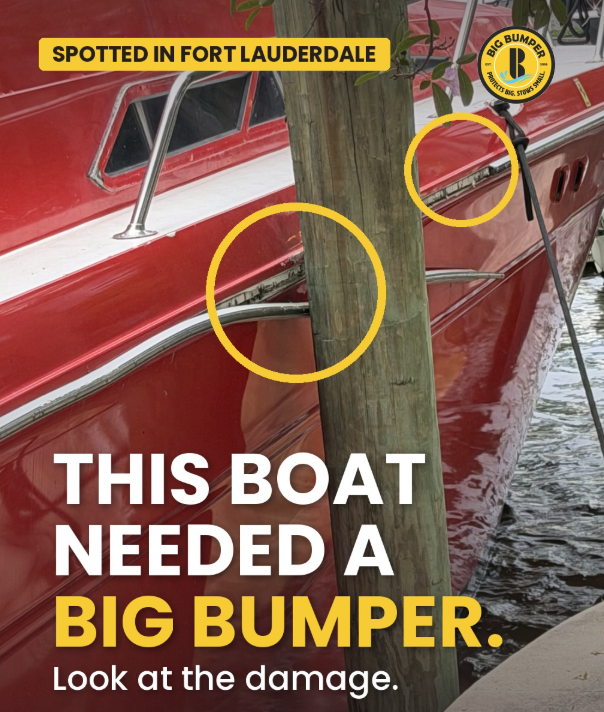
The owner didn't forget bumpers. There were a couple hanging a few feet away, right where they would have worked perfectly at a floating dock. That's the catch. The dock you tie up to decides how you bumpers, and a setup that works at one can leave you unprotected at the other.
Why the two docks behave differently
A floating dock moves with you. It rises and falls with the water, so your boat and the dock stay at the same height relative to each other. The contact point barely changes, and your bumpers have a long, flat edge to press against.
A fixed dock doesn't move at all. Your boat rides up and down the pilings with the tide and every passing wake, and it slides forward and back on its lines. The contact point is a narrow, round post, often set out past the edge of the dock itself.
How to bumper up at a floating dock
Hang them low. Floating docks sit close to the water, so your bumpers should too. Set the bottom of each bumper just above the waterline so it sits between the hull and the dock edge, not above it.
Cover the widest part of the boat. That's where contact happens first.
Watch for the small stuff. Floating docks shift and surge more than you'd expect, and inches add up. We covered that in The 6-Inch Problem.
How to bumper up against pilings
This is where the Riverwalk boat got into trouble.
Go horizontal. A bumper hanging vertically against a round piling will roll off to one side.
Cover the travel zone, not just the piling. Your boat is going to move fore and aft. Longtime cruiser Alvah Simon points out in Cruising World that a single standard fender laid sideways doesn't have much tolerance for that movement and can slide out from between the piling and the hull. The fix is length. Your protection has to be longer than the distance your boat can travel.
Check the piling before you tie up. Look up and down for nails, bolts, and old hardware. The tide will move your contact point, so inspect the whole post, not just the spot at eye level.
Tighten up the movement. Spring lines limit how far the boat can slide along the dock, which keeps your bumpers where you put them. If yours aren't doing that job, start with Your Dock Lines Aren't Working.
The traditional fix, and the simpler one
The classic answer to pilings is a fender board: a length of lumber hung outside two fenders so it bridges the piling. It works. It's also a six-foot plank you have to build, drill, and find a place to store.
A fender board solves the piling problem with length, and a long bumper does the same thing in one piece. A 6' or 12' Big Bumper has a D-ring at each end, so it hangs horizontally and puts several feet of cushion across the contact zone. The boat can slide forward and back, and the piling still meets bumper instead of gelcoat. When you cast off, it deflates and stows in a locker, which is more than you can say for a 2x6.
Not sure which length fits your boat? The Size Matters chart matches bumper size to boat size.
A quick check before you walk away
Is the dock floating or fixed?
Where will the hull actually touch: a flat edge or a post?
If the boat slides three feet forward or back, is there still a bumper in the way?
If the water drops, is there still a bumper in the way?
If you can answer yes to the last two, you can walk away from the boat without worrying about what you'll find when you come back.